Lofts may be Chicago’s swankiest architectural style du jour, but the exact standards that define a true loft condo in Chicago are fairly nuanced. Lofts don’t necessarily need exposed brick, nor do they need a “lofted” second-floor bedroom that’s open to space below. In fact, there are a few different types of lofts in Chicago that vary based on their construction date and structural or aesthetic elements.
If you’re thinking about buying a loft condo in Chicago, take a minute to learn more about the neighborhoods where you may have the most luck finding the loft of your dreams.
What is a loft condo?
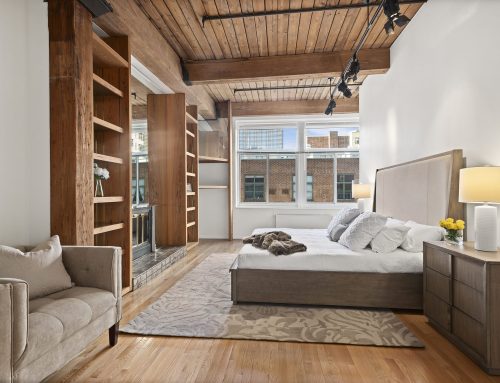
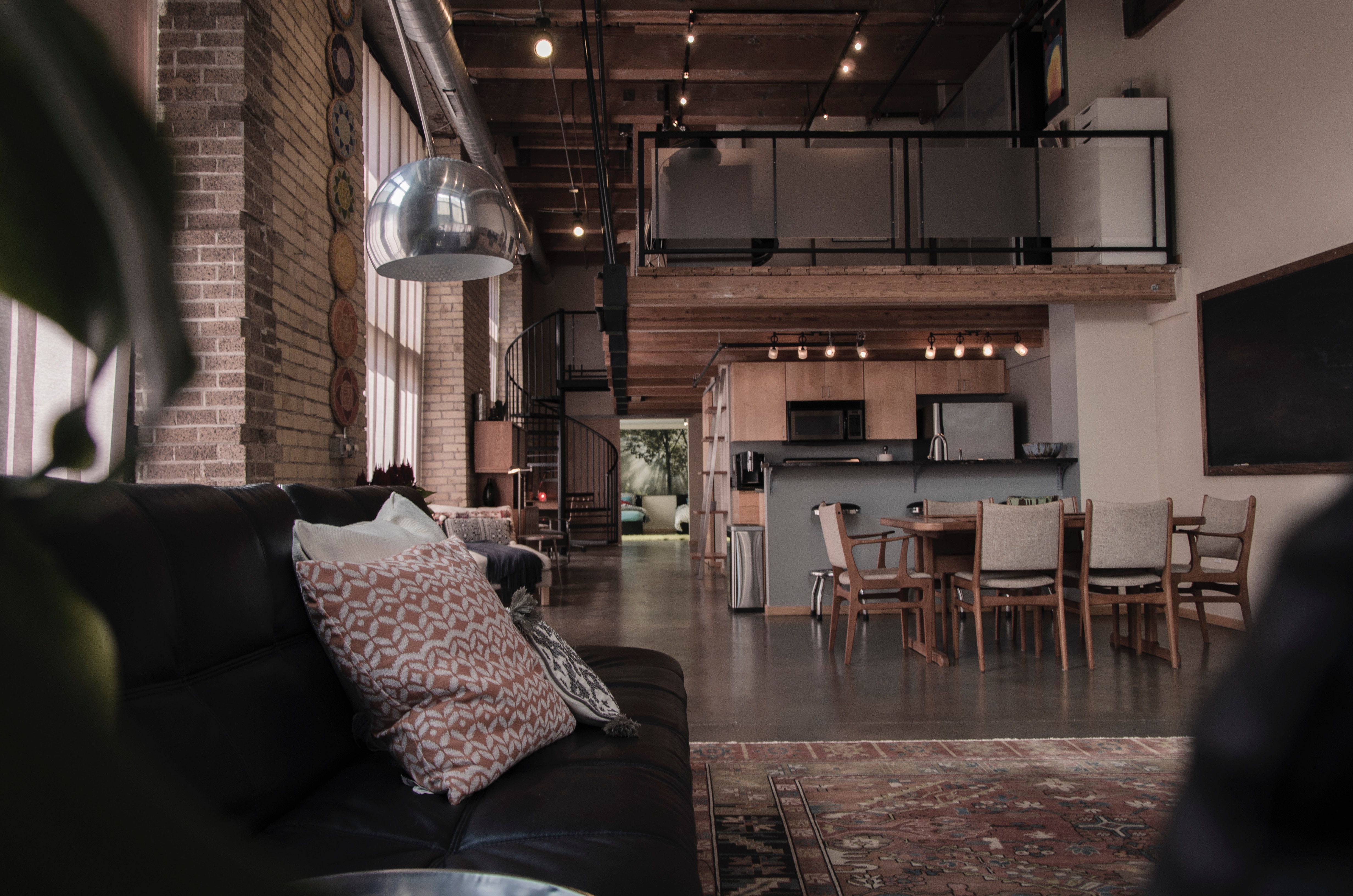
By definition, a loft home is any large, open space without internal walls, aside from those that define the bedroom(s) or bathroom(s). Many lofts feature interior freestanding walls that do not reach the ceiling, sometimes referred to as “partition” walls. While not load-bearing, freestanding walls provide privacy between the bedrooms and living spaces, still maintaining a stream of natural light throughout the space. Some even have a second level that’s open to the main living space below, a room or space that’s usually referred to as a “loft” in itself.
When someone says they are looking to buy a loft condo in Chicago, they are usually referencing a few other elements besides the open space concept or upper-level room(s). First, high ceilings are usually a must-have for loft-seeking homebuyers, no matter the presence of a second floor. Exposed brick or timber ceilings are not necessarily standard, but somewhat common given the prevalence of timber lofts for sale in Chicago. Finally, large, Warehouse-era windows are yet another customary feature that has grown in popularity as ample natural light becomes more of a must-have.
There are two primary types of lofts in Chicago – timber lofts (industrial loft conversions) and new construction lofts. Three Chicago neighborhoods where you are more likely to find these classic and sometimes contemporary homes are West Loop, River North, and South Loop.
West Loop loft condos
Because of its industrial roots, most within the meatpacking industry, the West Loop and Fulton Market District are popular neighborhoods to find timber lofts. Most loft condos across the Near West Side began as manufacturing facilities, later converted to affordable live-work spaces, and now regarded as appealing investments in a hip neighborhood with no shortage of new shops, offices and restaurants nearby. The sought-after 1000 W. Washington condos were formerly owned by Nabisco and converted to residential lofts in the mid-1990s. Together, 1000 W. Washington’s two buildings house over 180 units with 160 unique floor plans, creating an enticing opportunity for house hunters who cringe at the thought of “cookie cutter” homes. Other popular loft conversion condo buildings in the West Loop include 17 N. Loomis (Heartbreak Lofts), 15 S. Throop, 14 N. Sangamon, 1500 W. Monroe, 1017 W. Washington, 23 N. Green, and 331 S. Peoria.
In keeping with the West Loop’s loft scene, several new construction luxury condo buildings imitate traditional loft features with a contemporary, high-end twist. Hayden West Loop offers large windows, open-concept living spaces, high ceilings, and black window trim. Meanwhile, 900 West Washington, currently under construction, offers polished concrete floors, floor-to-ceiling windows, and nearly 11-foot ceilings. These buildings aren’t necessarily representative of the true loft-style residences the area is known for, but showcase a modern interpretation. The nod to industrial flair fused with luxury finishes helps attract a new wave of homebuyers to the area.
River North loft condos
Today, high-rises are almost synonymous with the River North landscape, but the area also has a lot to offer in terms of warehouse character. River North, originally referred to as “Smokey Hollow,” was initially a well-known factory hotspot clad with warehouses, shipping outposts and railroad tracks, the latter of which is now buried underneath Merchandise Mart. When it was built in the 1930s, Merchandise Mart was the largest building in the world with over 4 million square feet of floor space, predominately used as a storage warehouse – hardly the corporate office space and tourist destination Chicagoans know it for today. As warehouses began to shut down in the 20th century, River North became fairly desolate, at least until local artists began to inhabit the area in the ‘70s and ‘80s. But, those manufacturing roots exist still in the many loft-style residences that are scattered throughout the now buzzing River North community.
Units at 411 W. Ontario (Ontario St. Lofts), 154 N. Hubbard, 550 N Kingsbury (River Bank Lofts) and 375 W. Erie all feature sky-high timber ceilings, exposed brick walls, and a prime central location. Other notable mentions include 900 N. Kingsbury, 520 W. Huron, 300 W. Grand, 420 W. Grand, 360 W. Illinois, and 333 W. Hubbard. For a new development (as of 2015), the Ronsley condos at 676 N. Kingsbury feature characteristic loft materials, like high timber ceilings and black trim windows, mixed with custom elegant finishes like marble countertops and wide-plank hardwood floors. Plus, the building’s 41 residences have access to several onsite amenities, including a 24-hour doorperson, fitness center, yoga room, urban roof deck, entertainment center, dry cleaning service and, for an additional charge, electric car charging.
South Loop loft condos
Like West Loop and River North, the South Loop also has a rich manufacturing history that for a time revolved around a single industry: publishing. The area was one of the first residential areas in the city – even home to Marshall Field and George M. Pullman. As the South Loop welcomed new rail yards, tracks, and stations, the focus was on the commercial opportunity. Printer’s Row became the hub of Chicago’s printing presses in the 19th and early 20th centuries. Dearborn Station, opened in 1883, remains one of the area’s most distinguished landmarks. But with such heavy passenger traffic, the area attracted brothels and bars. In the mid-1900s, when new technology surpassed many printing institutions and the rail industry declined, vacancies skyrocketed. It was until the 1970s when developers set their eyes on the South Loop for Dearborn Park that the area began a swift transformation. The Donahue Building, originally built in 1883 as a publishing warehouse, was the first residential loft building in Chicago. As the years passed, more vacant warehouses were converted into condos, each helping the South Loop re-establish itself as a residential community filled with loft-style homes. Popular loft condo buildings in the South Loop include 2303 S. Michigan, 1801 S. Michigan, 900 S. Wabash, 1632 S. Indiana (Bicycle Station Lofts), 1322 S. Wabash, 1530 S. State (Dearborn Tower) and 711 S. Dearborn.
Not all of the lofts for sale in South Loop hold such an illustrious history. 520 S. State, also known as Library Tower, was erected in 2008. Because of its new(er) construction status, Library Tower holds conveniences you won’t see in many converted lofts, including a 24-hour doorperson, fitness center, movie theatre room, and rooftop deck. Inside, many units feature high concrete ceilings and updated appliances, all within a loft-style open layout.
Since lofts come in various shape, sizes and prices, pinpointing exactly which loft-like features you desire can help your Realtor locate homes that best match your search. To learn more about Chicago condo lofts, launch a condo loft home search or speak with a Realtor about condo loft neighborhoods, contact Z Chicago today.